Profile view of a bearded man wearing a black baseball cap and a dark gray T-shirt against a plain light background.

Why your water heater is leaking in South Dakota

Step 1 of 3: Equipment

Why is my water heater leaking?

A puddle under the tank or water dripping down the side gets your attention fast. Before you grab a bucket and tools, you want to know what's actually wrong and whether it's something to watch or something to act on now. Most of the time it comes down to a handful of causes, and where the water is coming from tells you a lot about which one you're dealing with.

Most leaks come from a failing tank, a loose fitting, or the pressure relief valve

Water pooling at the base usually means the tank itself has rusted through on the inside, and once that starts it doesn't stop. Water coming from the top or sides is often a loose supply line, a bad drain valve, or a pressure relief valve doing its job because pressure inside the tank is too high. Gas water heaters are what most homes in South Dakota run on, and a leak near the bottom can mean water hitting the burner chamber, which is worth getting looked at quickly. A slow drip doesn't mean a small problem. It means the tank is already failing somewhere you can't see.

A bathroom with a gray towel hanging on a bar against a taupe wall, a glass-enclosed shower with marble-look tile, showerhead and handheld sprayer, a window showing green trees, and a stone countertop with a sink at right.

You turn the shower on and wait for the steam that never comes. The water out of the tap stays cold, then lukewarm at best, and you figure the burner quit again. Barefoot, you go down to the basement in last night's clothes, and that's when you see it: a thin stream running down the side of the tank and pooling on the concrete. The towel's still folded on the rail upstairs, your coffee's getting cold on the counter, and you're already fifteen minutes behind for work. You crouch down and touch the puddle. It's wet, and it's spreading.

Is this leak something to worry about

You might find the puddle before anything else, just a damp patch on the concrete near the base of the tank. Or you catch it dripping from a fitting on top, where the pipes connect. Rust colored water is a different sign than clear water, and it usually means the tank itself has started to corrode from the inside. A few drops a day doesn't sound like much, but it adds up on the floor, and if that floor is near drywall or framing, standing water left for weeks can soften wood and feed mold. If the tank is cracked rather than just a loose fitting, the leak won't stop on its own and it tends to get worse, not better.

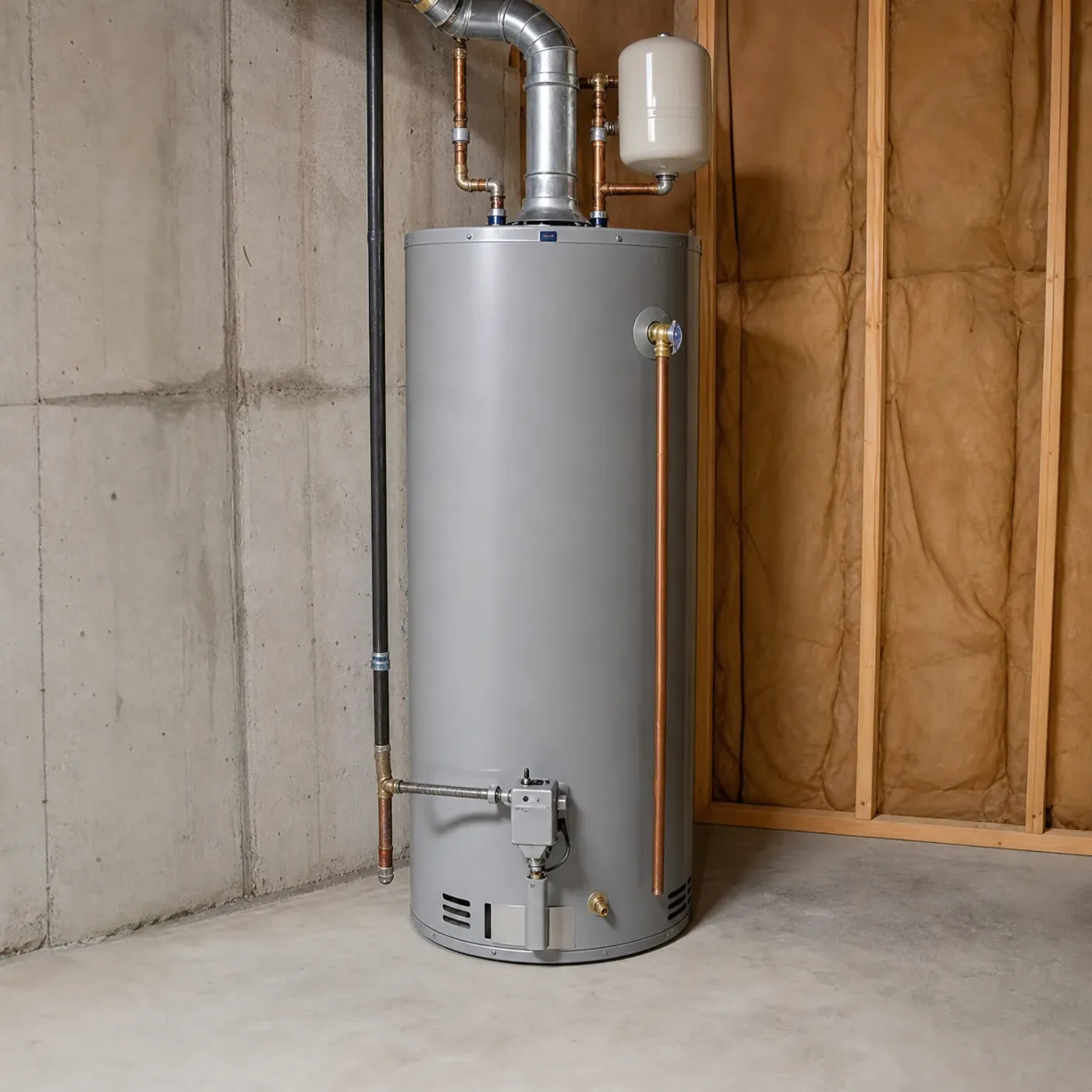
A gray cylindrical gas water heater with copper piping, flue vent, and a small expansion tank stands in a basement corner between a concrete wall and an insulated stud wall.

The tank holding steady

Copper lines run clean into the top of the tank, and the flue vent sits straight above it. The expansion tank above takes the pressure swings so the seams and fittings below don't have to. No damp spots, no rust trail down the side.

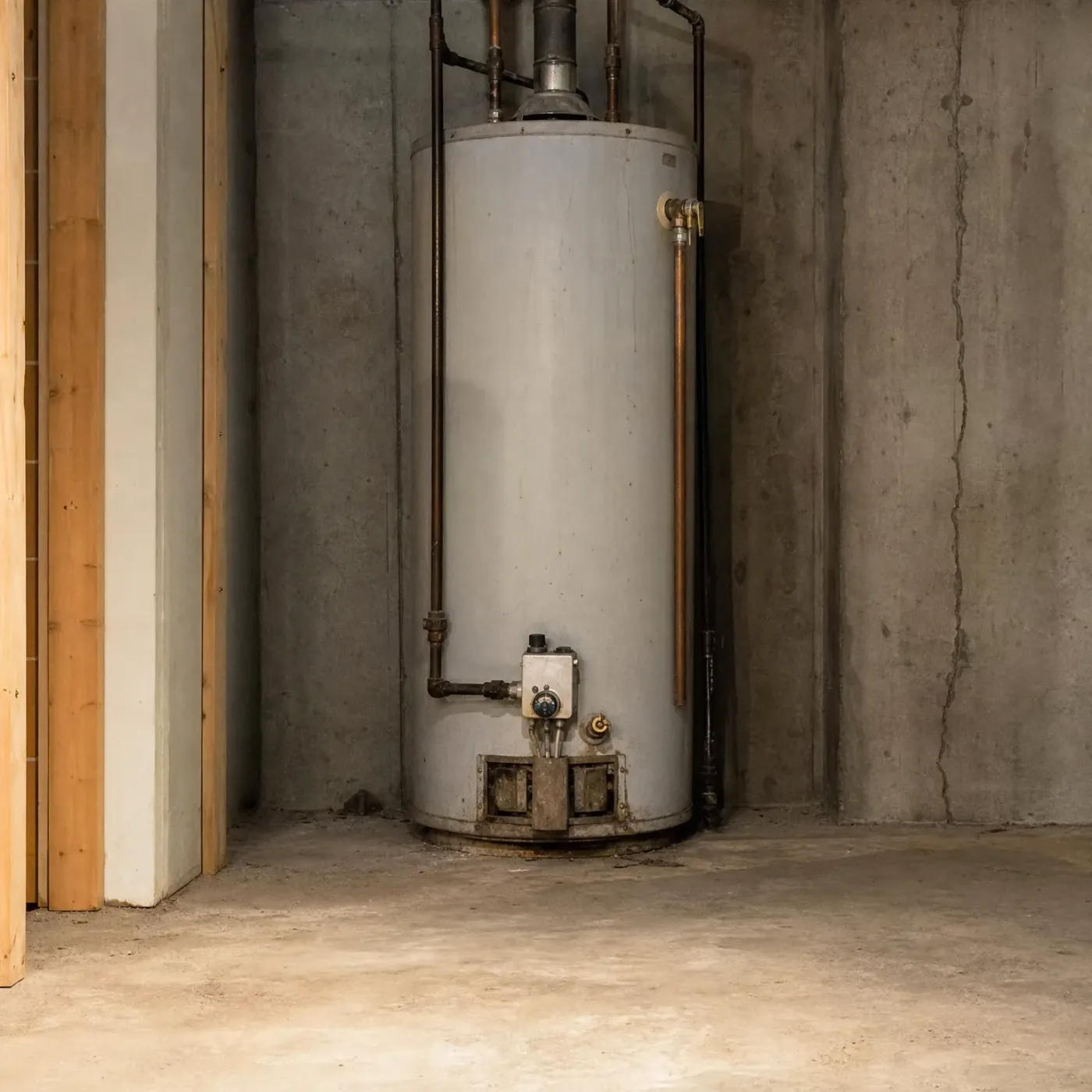
An older gas water heater with copper and black pipes stands in the corner of a bare concrete basement next to a wood-framed partition wall.

The tank giving out

This one sits in the corner on bare concrete, old enough that the gas control valve looks original. Supply and return pipes run straight down into a tank that's been holding water for years longer than most. A leak here usually means the tank itself, not just a loose fitting.

Fitting Leak or Tank Leak

Leak from a fitting

  • A fitting leak usually shows up as a drip or a damp spot right where a pipe or valve connects to the tank, not spread across the floor.
  • Tightening a loose connection or swapping a worn valve is a straightforward repair, and the tank itself is often fine.
  • The water pressure in your line can work a fitting loose over time, especially if that joint was never sealed quite right to begin with.
  • Catching this early means a contractor replaces one part instead of the whole system.
  • If the drip keeps pace with how much hot water you use, it's probably the fitting and not the tank wall.

Leak from the tank

  • Water pooling at the base of the tank, not at a fitting, usually means the steel tank itself has rusted through from the inside.
  • Gas water heaters in South Dakota often sit for years without the anode rod being checked, and that rod is what keeps the tank from corroding.
  • Once the tank wall gives out, there's no patch for it. The leak only gets worse from there.
  • A tank leak means replacement, not repair, since the steel holding the water is what failed.
  • Letting it sit means more water on the floor and the risk of damage to whatever is stored nearby in the basement.
A smiling man in a gray long-sleeved shirt stands in a kitchen looking to the side, with open shelves of dishes, a white mug on the counter, a potted plant, and a view through a doorway into a living room.
A smiling bearded man in a green sweater sits at a white marble kitchen island with a mug, potted plant and bowl of fruit, in a bright white interior with open shelving and an arched doorway.
A smiling man with dark curly hair and a beard, wearing a dark green knit sweater, stands at a white marble kitchen counter with a dark blue mug, with open shelving, pendant lights and a houseplant behind him.
A smiling man in a green ribbed sweater stands behind a wooden table holding a ceramic mug of coffee in a kitchen with white subway tile, shelves of potted plants, and a bowl of fruit.

Hand off the water heater problem

Fill out one short form instead of calling around.

Sending the form costs nothing.

A steel tank corrodes from the inside, and once rust works through the metal, nothing seals that hole back up.

A loose fitting just needs tightening or a new valve. A hole in the tank means the tank gets replaced.

A smiling man with dark curly hair in a navy t-shirt sits on a gray couch indoors, with a large-leafed plant and a window in the background.
A bearded man in a plaid flannel shirt stands in a kitchen looking out a window toward snow-covered shrubs, with a steaming mug on the windowsill and potted plants on a shelf behind him.

Leak you catch early

A damp patch by the base or a slow drip from a fitting gives you time to get someone out before it turns into standing water on the floor.

Hand it over

Leak you don't

A tank that's been rusting from the inside can go from a few drops to a steady stream with no warning, and by then the tank itself is done.

Hand it over
A closed silver laptop and a ceramic mug of dark coffee sit on a wooden table in front of two chair backs, with a kitchen counter, tiled backsplash, wooden cutting boards, a vase of greenery and a potted plant by a window behind.

What's actually happening inside the tank

Gas water heaters burn down there at the bottom, under the tank, and the heat runs up through a flue that passes through the center of the tank on its way out the roof. That flue is steel, same as the tank wall around it, and both sit in water every hour of every day. The anode rod hanging inside is the thing that's supposed to corrode first, a sacrifice so the tank doesn't have to. Once that rod is used up, the tank itself starts giving up metal instead, and that's a one-way process. No patch or sealant stops it once it starts, because the hole just opens wider from the inside where you can't reach it.

You could spend an afternoon on the phone finding out which of the contractors near you actually work on tanks instead of just installs, then explain the same leak story to three different people before you get a quote you trust. Send the form instead and that search is off your plate. Someone qualified gets in touch, and you go back to watching the game instead of scrolling reviews.

Interior corner of a room with a window and sheer curtain at left, a gray upholstered sofa with a cushion at right, and a round wooden table holding stacked books and a round vase with an olive branch.
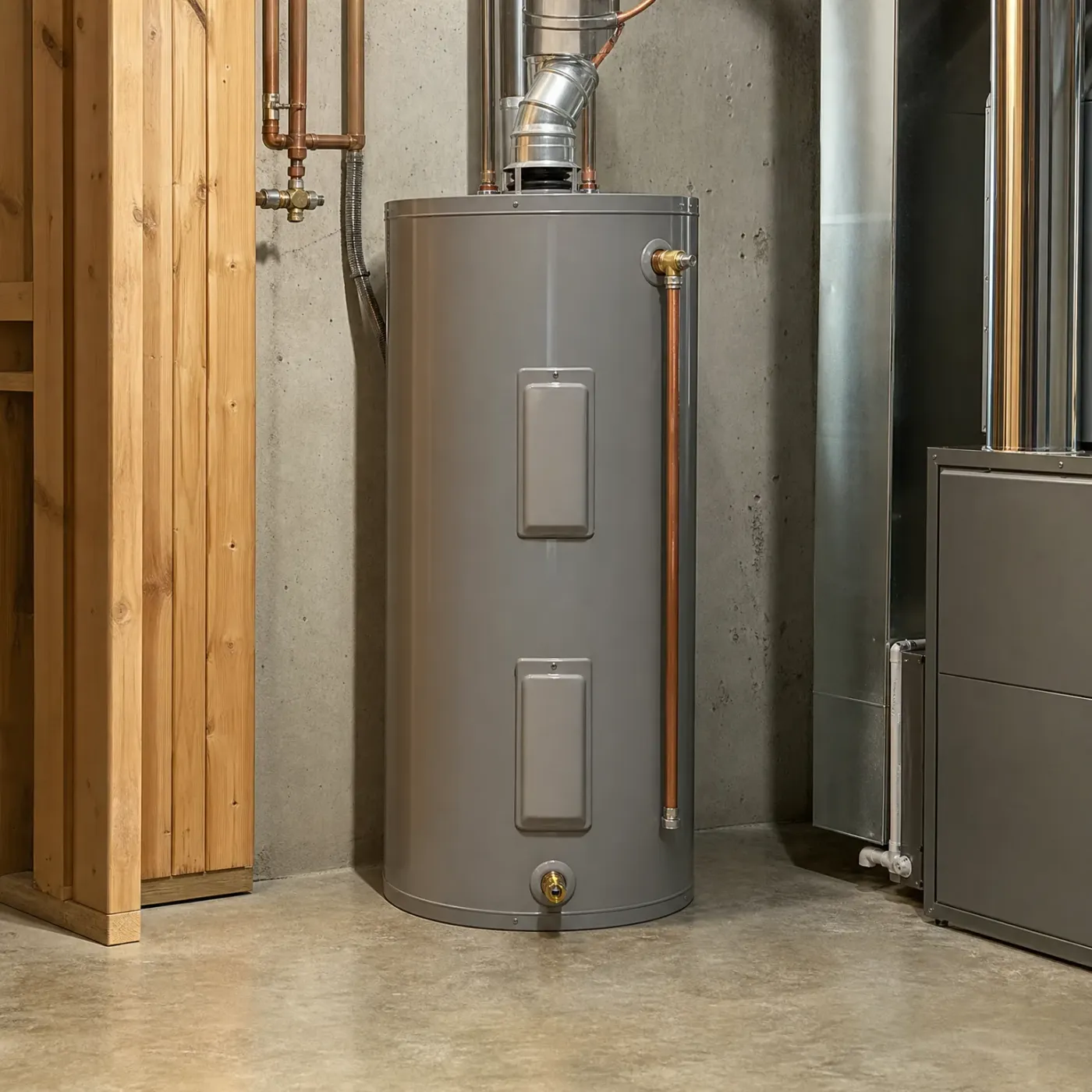
A gray cylindrical water heater with two access panels and copper piping stands against a concrete wall in a basement, beside wood framing and metal ductwork.

Tank still sound

Copper lines run straight into the top, fittings dry, no trail down the side. The flue vent sits centered and clean. A setup like this still needs the pressure relief valve and the fittings checked once in a while, but there's no rust working through the steel yet.

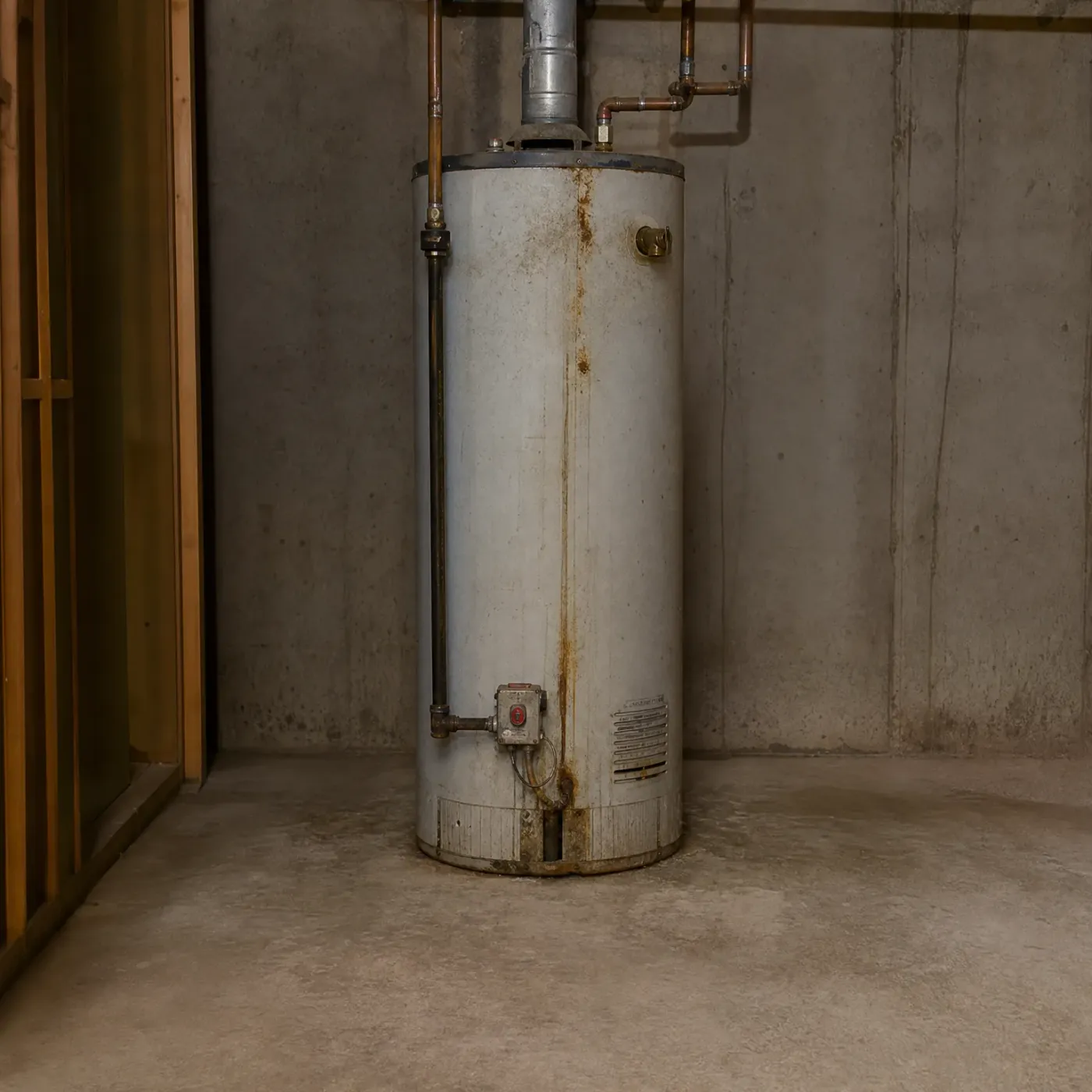
An aging rust-streaked gas water heater with copper and galvanized pipes stands against a bare concrete basement wall beside wooden stud framing.

Tank past saving

Rust has eaten through the jacket and the fittings near the base. A gas valve and thermostat sit low on a tank this far gone, and corrosion like this doesn't stop at the surface. Once it's through the outer metal, the tank wall underneath is going too, and no fitting repair fixes that.

47.6% of homes statewide heat with gas

Most homes in South Dakota heat water with gas, same as they heat the house. That gas water heater has a flue running straight up through the center of the tank, and that's the spot that rusts through first. If yours is leaking and it's gas fired, the tank itself is worth a look before anything else.

ACS 2020-2024 5-year B25040

A leak from a fitting gets fixed. A leak from a hole in the tank means a new water heater. That's the whole answer, and everything above walks through how to tell which one you're looking at. What you don't have to do is figure out who handles either job. You don't have to search through a list of plumbers, call around to see who answers, explain the puddle and the rust trail twice over to two different companies, then sit with three quotes trying to guess which one is fair. Send the form once and that work is off your plate. Someone licensed to work on gas water heaters in South Dakota gets the details and takes it from there. Whether it's a fifteen minute fix on a valve or a full tank swap, you're not the one tracking down who can do it. The leak already told you what kind of problem this is. Let it stop being the thing you have to solve alone.

A dark wood cabinet with a paneled door and a ceramic pot of green foliage on top stands in a beige-walled room with white baseboard, a window at left, hardwood floor, and a patterned area rug.
A dark wood glass-front cabinet holding folded towels, woven baskets and a ceramic vase stands in a bathroom corner beside a window, with a potted fern and stacked towels on top and a freestanding tub partly visible at left.
A woven basket holding a green cushion and a cream fringed knit throw sits on a wood floor in a room corner beside a window and a dark wooden cabinet.
Corner of a room with a dark wood cabinet topped by a round vase, a linen curtain at a window, white baseboard, oak plank flooring with sunlight patches, and a woven jute rug in the foreground.
A dark wood sideboard against a pale wall holds a shallow stone bowl and a round ceramic vase with leafy branches, with sunlight from a curtained window falling across the wall, wood floor and woven rug.

Done looking for a water heater pro

Skip searching for a water heater pro and answer a few questions instead.

Hand off my repair

It costs nothing to send, and you don't have to hire anyone.